Saree draping: heritage, styles, and meaning in 80 chars
A saree is not simply six yards of fabric. Over 100 draping styles exist across India, each shaped by region, ritual, climate, and personal identity. The way a saree is draped communicates who a woman is, where she comes from, and what occasion she is marking. This article covers the cultural significance of saree draping, the major regional styles, the mechanics behind a well-draped saree, and how modern innovation is reshaping this ancient practice.
Table of Contents
- What makes saree draping significant?
- How draping styles differ across India
- The mechanics of draping: What goes into a perfect saree?
- Contextual meaning: Saree draping for rituals, festivals, and daily life
- Saree evolution: Innovation meets tradition
- Elevate your saree journey with Khanduapata
- Frequently asked questions
Key Takeaways
| Point | Details |
|---|---|
| Cultural identity | Saree draping highlights regional and cultural differences across India. |
| Drape variety | Over 100 styles exist, each adapted for rituals, work, and daily life. |
| Symbolism and meaning | How you drape a saree signals tradition, status, and values. |
| Modern adaptation | Today’s saree styles blend innovation with tradition for every lifestyle. |
What makes saree draping significant?
Saree draping is not a uniform practice. It carries layers of meaning that vary by community, geography, and life stage. Understanding these layers helps explain why draping is treated as a skill worth preserving.
Saree draping signifies regional identity, marital status, occupation, and spirituality, preserving India’s cultural diversity. A widow in Bengal drapes differently from a bride in Tamil Nadu. A farmer in Maharashtra uses a style built for physical work. These are not aesthetic choices alone. They are functional and social signals.
Saree draping also marks key life events:
- Weddings: Specific drapes signal bridal status and family lineage.
- Festivals: Draping styles shift to reflect devotion and community belonging.
- Spiritual rituals: Certain styles are reserved for prayer and temple visits.
- Daily wear: Simpler, faster drapes serve practical needs.
- Mourning: Some communities use plain, unadorned draping to mark grief.
“The saree is not just clothing. It is a record of a woman’s place in her community, her faith, and her history.”
Modern women are also reclaiming traditional drapes as a form of cultural pride. Choosing a regional style over the default Nivi drape is a deliberate statement. It connects the wearer to a lineage. For a deeper look at what sarees represent beyond fabric, the discussion of saree symbolism and craftsmanship provides useful context. If you are selecting a saree for a specific occasion, the traditional saree selection guide covers the key factors.
How draping styles differ across India
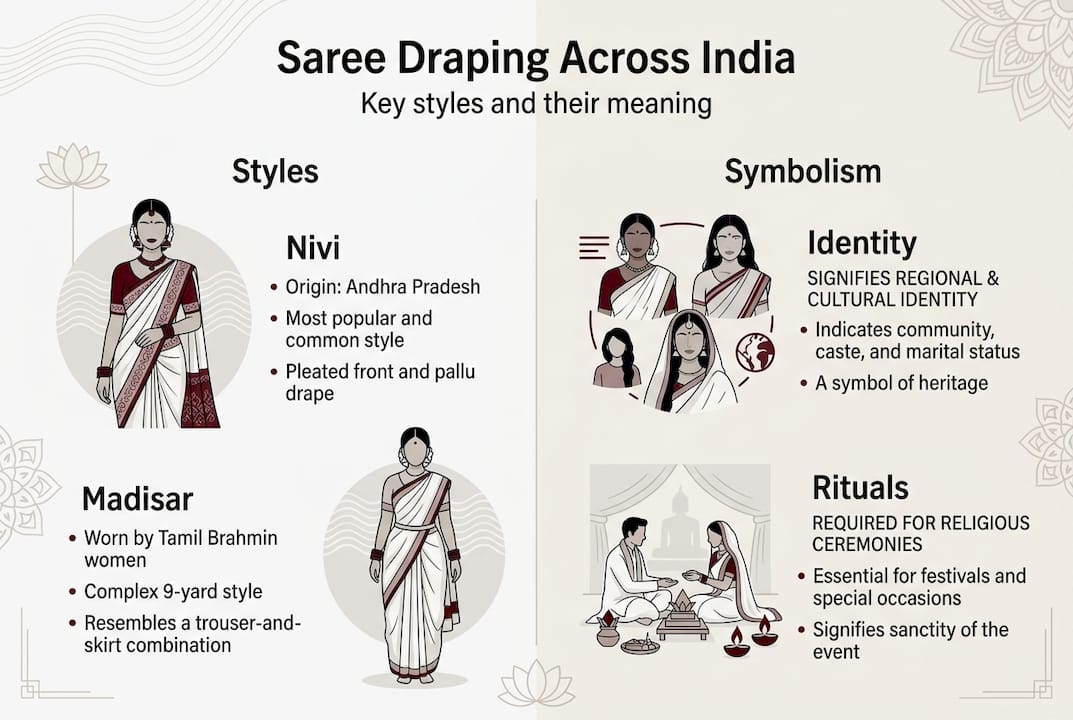
India’s regional draping styles are distinct in structure, length, and symbolism. Saree draping styles vary regionally across India, each reflecting unique cultural, historical, and practical significance. The differences are visible in pleat direction, pallu placement, and whether a petticoat is used.
Here is a comparison of major draping styles:
| Style | Region | Key feature | Occasion |
|---|---|---|---|
| Nivi | Andhra Pradesh | Front pleats, pallu over left shoulder | Everyday, formal |
| Madisar | Tamil Nadu | 9-yard, dhoti-style lower half | Brahmin rituals |
| Bengali Atpoure | West Bengal | Wide box pleats, pallu over both shoulders | Durga Puja, rituals |
| Nauvari | Maharashtra | 9-yard, no petticoat, dhoti wrap | Festivals, daily wear |
| Coorgi | Karnataka | Pallu pinned at back, pleats behind | Weddings, ceremonies |
| Gujarati | Gujarat | Pallu draped over right shoulder to front | Festivals, weddings |
Nivi style, originating from Andhra Pradesh, is the most common drape with front pleats and pallu over the left shoulder, popularized in colonial times for modesty. Its wide adoption across India is largely due to its clean silhouette and ease of movement.
Key features that distinguish regional styles:
- Pleat direction: Forward-facing in Nivi, backward in Coorgi.
- Pallu placement: Single shoulder, double shoulder, or pinned at back.
- Fabric length: Standard six yards vs. nine yards for Madisar and Nauvari.
- Undergarments: Petticoat used in most styles; absent in 9-yard drapes.
- Pinning: Some styles rely on tucks alone; others use safety pins for security.
For a step-by-step breakdown of how to execute these styles, the guide on perfect saree draping steps is a practical reference.
The mechanics of draping: What goes into a perfect saree?
Draping a saree correctly requires attention to sequence and proportion. The process is repeatable once the core steps are understood.
Here is the standard draping sequence for a six-yard saree:
- Wear the petticoat at waist height. The petticoat provides the base for tucking and keeps the saree in place.
- Tuck the plain end into the petticoat, starting from the right side and wrapping once around the body.
- Form the pleats. Pleats are typically 5 to 9 inches wide, with 5 to 8 pleats formed depending on the style and fabric weight.
- Tuck the pleats into the petticoat at the center front, pointing slightly left.
- Wrap the remaining fabric around the body once more.
- Drape the pallu over the left shoulder. Adjust the length based on preference or style requirements.
- Secure with pins at the shoulder and waist if needed for stability.
The blouse and petticoat are not optional accessories. They are structural components. The blouse supports the pallu and defines the upper silhouette. The petticoat anchors the tucks. For 9-yard styles like Madisar and Nauvari, the saree itself provides enough fabric to create a secure fit without a petticoat.
Pro Tip: Use a thin cotton petticoat in a color that matches the saree border. This prevents color bleed-through on lighter fabrics and keeps the overall look clean.
For guidance on blouse construction that complements different draping styles, the resource on blouse patterns for sarees covers current options. The saree craftsmanship guide explains how fabric type affects draping behavior.
Contextual meaning: Saree draping for rituals, festivals, and daily life
The same woman may drape her saree differently on a Tuesday morning versus a festival evening. Context determines the choice. This is not about fashion. It is about function and meaning.
The Madisar drape from Tamil Nadu, used by Brahmin women, is a 9-yard style resembling a dhoti and saree, worn for rituals symbolizing purity and Vedic traditions. The structure of the drape itself is considered an act of preparation for sacred space.
The Bengali Atpoure style features wide box pleats and a pallu over both shoulders, used in rituals and festivals like Durga Puja. The double-shoulder pallu is a visual marker of ceremonial intent.
Here is how common draping styles map to occasions:
| Draping style | Primary occasion | Symbolic meaning |
|---|---|---|
| Madisar | Brahmin rituals, weddings | Purity, Vedic tradition |
| Bengali Atpoure | Durga Puja, rituals | Devotion, community |
| Nivi | Everyday, formal events | Modesty, elegance |
| Nauvari | Festivals, daily work | Strength, practicality |
| Coorgi | Weddings, ceremonies | Honor, family lineage |
Statistic: India observes more than 30 major festivals annually, many of which involve specific dress codes tied to regional saree draping traditions.
Pro Tip: If you are attending a regional festival outside your home state, research the local draping style beforehand. Wearing the regional style is recognized as a mark of respect by local communities.
For occasions involving saree gifting, the saree gifting traditions guide outlines the protocols. To maintain the quality of handloom sarees used in rituals, the resource on preserving saree heritage provides care instructions.
Saree evolution: Innovation meets tradition
Saree draping is not static. It has adapted across centuries, and the current generation is accelerating that change.
Modern evolution includes pre-draped, pant-style, and belted sarees for convenience, contrasting traditional hand-draping. These formats reduce the time and skill required to wear a saree, making the garment accessible to younger women and those unfamiliar with regional techniques.
Current innovations in saree draping include:
- Pre-stitched sarees: The pleats and pallu are pre-set. The wearer steps in and fastens the garment in minutes.
- Pant-style sarees: The lower half is stitched as trousers, with the pallu draped over the top. This style is popular at formal events and in urban settings.
- Belted sarees: A belt cinches the waist over the draped fabric, adding structure and a contemporary silhouette.
- Jacket and cape pairings: Traditional drapes are paired with structured outerwear, blending regional styles with global fashion.
- Fusion draping: Designers combine elements from multiple regional styles into a single look.
These changes do not erase traditional draping. They run alongside it. Many women who wear pre-stitched sarees on weekdays choose to learn and wear traditional drapes for weddings and festivals. The two approaches coexist. For a broader view of current saree options that reflect both heritage and modern design, the collection of modern saree trends online is a useful reference.
The next generation’s engagement with saree draping will likely be shaped by access to information, exposure to regional styles through social media, and the availability of sarees that balance tradition with practicality.
Elevate your saree journey with Khanduapata
Understanding saree draping styles and their significance is the first step. The next step is finding sarees that support the draping style you want to practice or explore.
At Khanduapata, the collection includes handwoven sarees designed with attention to fabric weight, weave structure, and border detail, all of which affect how a saree drapes. The elegant Chanderi silk sarees offer a lightweight option suited to Nivi and Gujarati draping styles. The traditional tribal Chanderi sarees carry motifs rooted in regional craft traditions. To browse the full range of handwoven options, discover unique sarees across categories including cotton, silk, and specialty weaves.
Frequently asked questions
How do different saree drapes reflect cultural diversity in India?
Each draping style represents a specific region, community, or ceremony, preserving unique traditions and identities. The variation in pleat structure, pallu placement, and fabric length all carry distinct cultural information.
What is the Nivi drape and why is it common?
The Nivi drape from Andhra Pradesh features front pleats and a pallu over the left shoulder, popularized during colonial times for its modest and elegant appearance. Its clean structure makes it adaptable across fabrics and body types, which explains its widespread use.
Why do some saree drapes use 9 yards of fabric without a petticoat?
Styles like Madisar and Nauvari use a full 9-yard saree tied to resemble both a dhoti and a saree, providing structural stability through the wrap itself rather than an undergarment. The extra fabric creates a secure fit that holds without additional support.
How has saree draping evolved in recent years?
Modern sarees include pre-draped, pant, and belted styles that reduce the time and skill required to wear the garment. These formats make saree wearing more accessible while traditional hand-draping continues in ritual and ceremonial contexts.