Motifs in saree design: origins, meaning, and trends
TL;DR:
- Motifs in sarees carry cultural, symbolic, and historical significance beyond decoration.
- Placement and design of motifs reflect regional identity and occasion-specific symbolism.
- Traditional techniques like Jungu and Adai influence motif texture, while modern methods enable innovation.
Motifs in saree design are often dismissed as simple decorative elements. That assumption misses the point entirely. A single design unit such as a flower, leaf, paisley, bird, or geometric shape carries cultural weight, historical context, and symbolic meaning that goes far beyond visual appeal. This article covers what motifs are, where they come from, how they are made, and how you can recognize and select them in sarees available today. By the end, you will have a clear, practical understanding of motif significance in Indian textile design.
Table of Contents
- What is a motif in saree design?
- Traditional motifs: Symbolism and origins
- Motif creation: Techniques and evolution
- Applying motif knowledge: Recognizing patterns in sarees today
- The untold importance of motifs in saree design
- Discover motif-rich sarees at Khanduapata
- Frequently asked questions
Key Takeaways
| Point | Details |
|---|---|
| Motifs explained simply | Motifs are repeating design units in sarees that carry cultural and symbolic meaning. |
| Historical and cultural value | Traditional motifs connect saree design to regional stories and heritage. |
| Evolution of techniques | Handloom motifs evolved with technology, making intricate patterns more accessible. |
| Recognizing modern motifs | Modern sarees mix traditional motifs with new styles, visible in retail collections. |
| Choosing motif-rich sarees | Understanding motifs helps you select sarees that best match your personal and cultural preferences. |
What is a motif in saree design?
A motif is the foundational unit of pattern in any textile. In saree design specifically, a motif is a single design unit such as a flower, leaf, paisley, bird, or geometric shape that is repeated to create patterns across the fabric. It is not the pattern itself. It is the building block from which patterns are constructed.
Think of a motif as a single word in a sentence. On its own, it carries meaning. Repeated and arranged, it forms a larger visual narrative. This distinction matters when you are evaluating traditional saree motifs for purchase or appreciation.
Motifs appear in specific locations on a saree. Each placement has its own visual and cultural function.
- Border (zari or woven edge): Motifs here frame the saree and define its visual boundary.
- Pallu (the decorative end panel): This area carries the most elaborate motif work, often the focal point of the design.
- Body (the main drape area): Motifs here may appear as scattered singles, rows, or all-over jaal (net) patterns.
- Blouse piece: Smaller motifs often mirror or complement the main saree design.
The most common motif forms found in Indian sarees include the following:
| Motif type | Common form | Typical placement |
|---|---|---|
| Floral | Rose, lotus, marigold | Pallu, body, border |
| Paisley (mango/keri) | Teardrop with curved tip | Border, pallu |
| Geometric | Checks, triangles, diamonds | Body, border |
| Bird | Peacock, parrot, swan | Pallu, border |
| Leaf and vine | Creeper, single leaf | Border, jaal patterns |
Each motif type carries its own visual weight. Geometric motifs tend to create structured, formal looks. Floral and bird motifs produce softer, more traditional aesthetics. The choice of motif directly shapes the overall character of the saree.
Traditional motifs: Symbolism and origins
Motifs in Indian sarees are not arbitrary design choices. They carry symbolic, aesthetic, and narrative functions, placed in borders, pallus, or all-over jaal patterns. Modern adaptations blend tradition with contemporary design, but the symbolic roots remain intact in many handloom traditions.
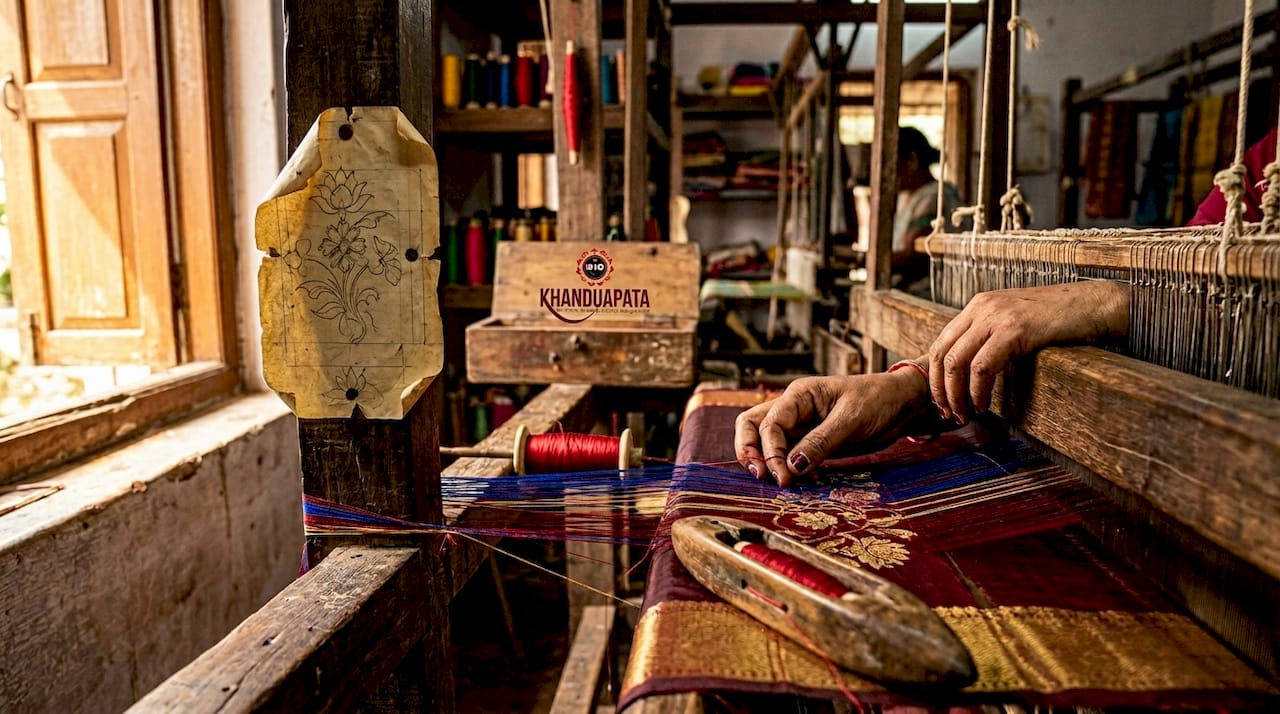
Historically, motifs drew from the natural world and daily life. Nature-based motifs such as the lotus, peacock, and mango were among the earliest recorded forms. The lotus represented purity and spiritual growth. The peacock symbolized grace and prosperity. The mango or paisley shape, known locally as the keri, became one of the most recognized symbols in Indian textile history.
Religious influence also shaped motif development. Temple architecture, deity iconography, and ritual objects directly informed the visual vocabulary of weavers. This is particularly visible in silk saree symbolism, where motifs tied to specific deities or auspicious occasions are woven into the fabric with deliberate intent.
“Motifs serve symbolic, aesthetic, and narrative functions, placed in borders, pallus, or all-over jaal patterns; modern adaptations blend tradition with contemporary design.” — Indian motifs shaping textiles
Placement of motifs also carries meaning. A border motif defines the boundary of the garment and often signals the wearer’s regional or community identity. Pallu motifs are reserved for the most elaborate work because the pallu is the most visible section when the saree is draped. The way a saree is draped and what motifs appear in each section are interconnected aspects of saree draping meaning.
The contrast between traditional and modern motif use is significant:
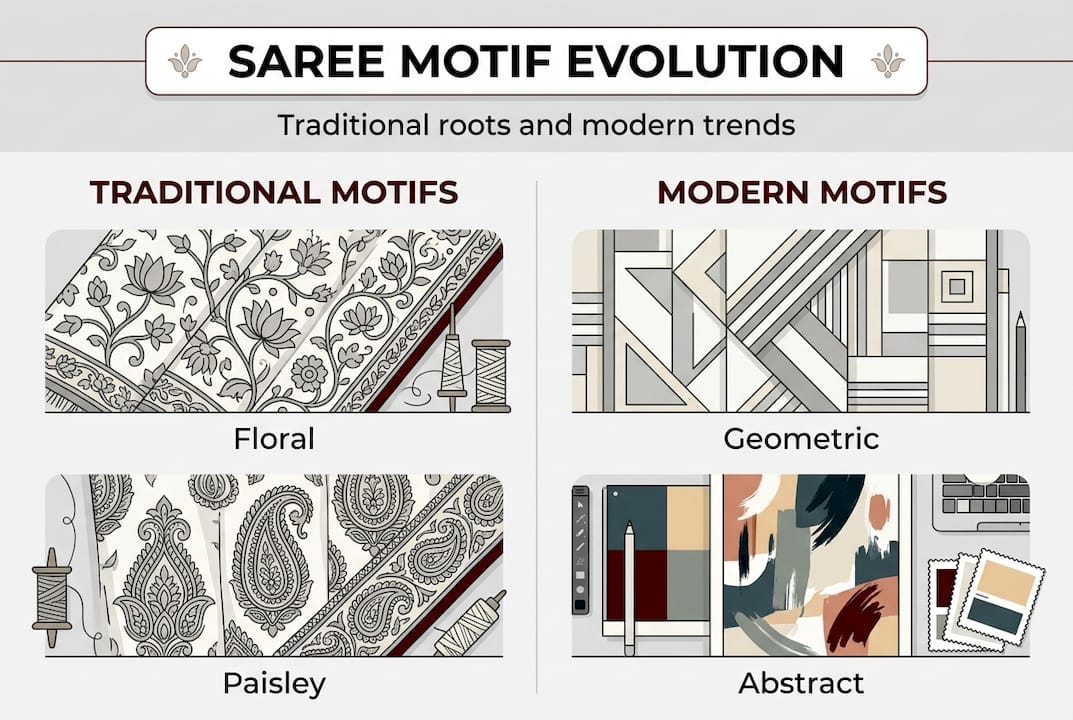
| Feature | Traditional motifs | Modern motifs |
|---|---|---|
| Inspiration source | Nature, religion, daily life | Abstract art, global trends |
| Technique | Handloom, hand-drawn | Jacquard, digital printing |
| Symbolism | Culturally specific | Often decorative |
| Placement | Defined by convention | Flexible, experimental |
Understanding these contrasts helps you assess the cultural depth of any saree you are considering.
Motif creation: Techniques and evolution
The meaning of a motif is inseparable from how it is made. Production technique determines the level of detail, the texture, and the authenticity of a motif.
The following methods represent the main stages of motif creation in Indian saree weaving:
- Jungu technique: A traditional handloom method used in Arani silk sarees where the weaver manually controls each thread to produce motifs.
- Adai technique: A supplementary weft method that allows weavers to insert extra colored threads to form motif shapes within the base fabric.
- Jacquard loom: A mechanical attachment introduced to Arani silk weaving after 1995 that uses punched cards or digital inputs to automate complex motif patterns.
- Powerloom production: Fully mechanized weaving that replicates motifs at high speed and low cost, though with reduced textural depth.
- Digital printing: A modern method that applies motif designs directly onto fabric using inkjet technology, allowing photographic detail but lacking the tactile quality of woven motifs.
In traditional Arani silk sarees, motifs were created using the Jungu or Adai technique until 1995, after which jacquards were introduced to allow greater variety while preserving simple motif forms. This shift is representative of a broader pattern in Indian saree craftsmanship.
Pro Tip: When evaluating a saree’s motif quality, run your fingers across the surface. Handloom and jacquard woven motifs have a raised, textured feel. Printed motifs lie flat and lack dimensional depth.
Technology has made motif-rich sarees more accessible. However, it has also contributed to the decline of certain specialized handloom skills. The heritage handloom trends visible in 2026 reflect an effort to balance innovation with preservation. Some weaving communities now use jacquard technology specifically to sustain traditional motif vocabularies that would otherwise be too labor-intensive to produce commercially.
The result is a textile landscape where traditional motif knowledge is being encoded into modern machinery, keeping the visual language alive even as the production method changes.
Applying motif knowledge: Recognizing patterns in sarees today
Knowing what motifs are and where they come from is useful. Knowing how to spot them in a retail or market setting is practical. Motifs analyzed semiotically reveal categories like nature and daily objects, with a decline in traditional craft due to powerlooms, but innovations sustain the craft via jacquards.
Here is how to identify motifs in sarees you encounter:
- Start with the border. The border motif is usually the most consistent and clearly defined. Identify the base shape being repeated.
- Examine the pallu. The pallu motifs are typically larger and more complex. Look for the primary motif form, whether it is a bird, flower, or geometric shape.
- Check the body for jaal patterns. A jaal is an all-over repeating motif grid. If you see a continuous pattern across the main drape area, you are looking at a jaal design.
- Look for solo motifs (butis). Small individual motifs scattered across the body are called butis. They are common in both cotton and silk sarees.
- Assess texture. Touch the motif area. Woven motifs feel raised. Printed motifs feel flat.
For motif selection, consider the occasion and the visual weight you want. Heavy pallu motifs suit formal events. Subtle buti patterns work for daily or office wear. If you are selecting blouse motifs, aim for designs that echo the saree’s main motif without duplicating it exactly.
Pro Tip: For multicolor motif sarees, check whether the motif colors are woven in or printed. Woven multicolor motifs indicate higher craftsmanship and greater durability over time.
Contemporary trends in 2026 show increasing interest in geometric and abstract motifs alongside traditional floral forms. Buyers are combining heritage motif sarees with modern blouses and accessories, creating a blend that respects tradition while fitting current fashion contexts.
The untold importance of motifs in saree design
Motifs are routinely treated as a secondary consideration in saree buying. Most buyers focus on color, fabric, and price. Motifs are evaluated last, if at all. This approach underestimates what motifs actually do.
Motifs serve symbolic, aesthetic, and narrative functions. They are the element most directly connected to regional identity, craft heritage, and cultural continuity. A saree without meaningful motif work is a fabric. A saree with deliberate motif design is a document of cultural knowledge.
For gifting purposes, motif selection matters more than most buyers realize. A saree chosen for a specific occasion should carry motifs appropriate to that occasion. Auspicious motifs for weddings, nature motifs for festivals, and geometric patterns for formal contexts all communicate intent. A guide to saree gifting workflow can help you align motif choice with occasion.
The practical wisdom here is straightforward. Learn the motif vocabulary of the textile traditions you are drawn to. That knowledge will improve every purchase decision you make.
Discover motif-rich sarees at Khanduapata
Khanduapata offers handwoven sarees where motif design is central to every piece. The collections reflect the motif traditions discussed in this article, from nature-inspired forms to geometric patterns.
You can explore a plant motif saree that reflects the nature-based motif tradition in pure cotton handweaving. For a more formal option, a floral motif saree in Chanderi silk demonstrates how traditional motif forms translate into contemporary designs. The full motif saree collection covers a range of motif types, placements, and fabric options suited to different occasions and preferences.
Frequently asked questions
Why are motifs important in saree design?
Motifs serve symbolic, aesthetic, and narrative functions, conveying cultural meaning and telling visual stories through repeated patterns. They define a saree’s regional identity and craft heritage.
How can I distinguish different motifs on a saree?
Look for repeated units such as flowers, paisleys, leaves, or geometric shapes. A single design unit repeated across borders, pallus, or the body of the saree is the motif.
What are the traditional techniques for creating saree motifs?
Handloom methods like Jungu and Adai were standard before jacquard and powerloom methods changed production. In traditional Arani silk sarees, jacquards replaced the Jungu technique after 1995 to allow greater motif variety.
Are motifs in sarees still relevant in modern fashion trends?
Yes. Modern adaptations blend tradition with contemporary design, keeping motifs culturally relevant while appealing to current tastes across both handloom and powerloom markets.
Recommended
- Saree draping: heritage, styles, and meaning in 80 chars – Khanduapata
- Understanding saree craftsmanship: a guide for 2026 – Khanduapata
- Heritage saree styles: Authentic handloom trends for 2026 – Khanduapata
- Benefits of gifting sarees: tradition meets elegance – Khanduapata
- Tattoo-inspired art: Styles and meaning for mindful design – Memento Vivere Co
- Symbolism in goth fashion: what your dark attire reveals – GothMarket